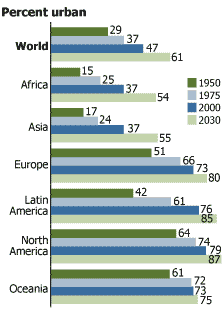
Urbanization shapes how people live and how communities use land, water, energy, and other resources. Cities offer jobs, education, health care, and transportation, attracting people in search of opportunity. But rapid growth can strain housing and infrastructure, increase pollution, and reduce farmland and vegetation. Understanding these effects is important because communities need to support people’s well being without damaging the environment everyone depends on.
The challenge is not simply to stop cities from growing. Urban growth is not automatically harmful. Well-planned cities can make public transportation and essential services easier to access, while compact neighborhoods can reduce the need for long car trips. The real question is how to make growth work for residents without damaging the natural systems everyone depends on. This requires comparing the benefits of new housing, jobs, and infrastructure to their effects on communities and the environment. It also requires planning ahead, so roads, transit, water systems, schools, and health services can meet residents’ needs as cities expand.
The issue becomes especially serious when essential resources are limited. If clean water, food, housing, and health care do not keep pace with population growth, people may face worsening living conditions. Urban growth is not automatically harmful. Well-planned cities can make services and public transportation more accessible. The challenge is ensuring that growth is managed fairly and sustainably.
Several approaches can help. Compact urban planning can encourage walkable neighborhoods and development near public transportation instead of low-density sprawl. This can reduce car use and help preserve farmland and natural areas. However, updating aging infrastructure and building better housing and transit can be expensive and politically difficult. Planning must also include affordable housing so improvements do not displace lower-income residents.
Responsible resource use is another part of the solution. Renewable energy, recycling, and efficient water systems can reduce environmental pressures as cities grow. Reducing excessive consumption can also conserve resources for present and future generations. These efforts may require investment and changes in everyday habits, and they cannot replace sound public policy.
There is no single blueprint for every city. Population projections vary widely, and future trends depend on birth and death rates, economic conditions, and access to education and health care. Communities also need better long term evidence about which planning policies work best and how they affect housing affordability, public health, ecosystems, noise, and light pollution.
A practical balance begins with decisions made alongside the people affected by them. Communities can direct development toward existing urban areas, invest in reliable public transportation and resilient infrastructure, protect green space and farmland, and monitor whether residents can afford housing and access basic services. No single solution will meet every community’s needs. Cities will continue to change as people seek opportunity. With inclusive planning and careful resource management, that change can expand opportunity while limiting harm to people and the environment.
(475)